

WhatsApp API hosting types: a two-minute history
Understanding the jargon requires one piece of history. The WhatsApp Business API originally shipped as On-Premises software: a container stack that a Business Solution Provider ran on its own servers for you. Getting API access meant going through a BSP, and each BSP's hosting, uptime and pricing differed.
In 2022 Meta launched the Cloud API, the same API, hosted by Meta itself, and opened it to businesses directly. It then deprecated the On-Premises version, with the sunset completing in late 2025.
As of August 2026, every WhatsApp API message flows through Meta's Cloud API, whoever you signed up with. "Cloud API vs BSP" is therefore not a hosting comparison any more. It's a question about the layer on top:
- Cloud API direct: your developers integrate against Meta's Graph API endpoints themselves.
- Through a BSP or platform: a provider handles onboarding and gives you ready software on the same underlying API.
One more term you'll meet: Tech Provider. Since Meta opened embedded signup, companies that aren't formal BSPs can also onboard businesses onto the Cloud API through Meta's official flow. From your side the experience is similar, the questions to ask (below) are the same. If you're starting from zero, our guide on how to get the WhatsApp Business API walks through the actual signup.
Cloud API direct from Meta: what you get, and what you don't
Going direct is genuinely free of platform fees: you create a Meta app, connect a number, and pay only Meta's per-conversation charges. For a developer, the API itself is clean, REST endpoints to send messages, webhooks to receive them.
What you don't get is everything around the API. There is no inbox: incoming messages arrive as webhook payloads to your server, and if a human needs to read and answer them you must build that screen. No campaign tool, sending 2,000 templates means writing the batching, retry and error handling yourself.
Template creation happens in Meta's WhatsApp Manager, which is workable but thin. No contact management, no bot builder, no analytics beyond raw message statuses, and support means Meta's developer documentation and support tickets. Direct integration is the right call when WhatsApp is a feature inside your own product and you have engineers to own it, the same reason our developer API guide exists.
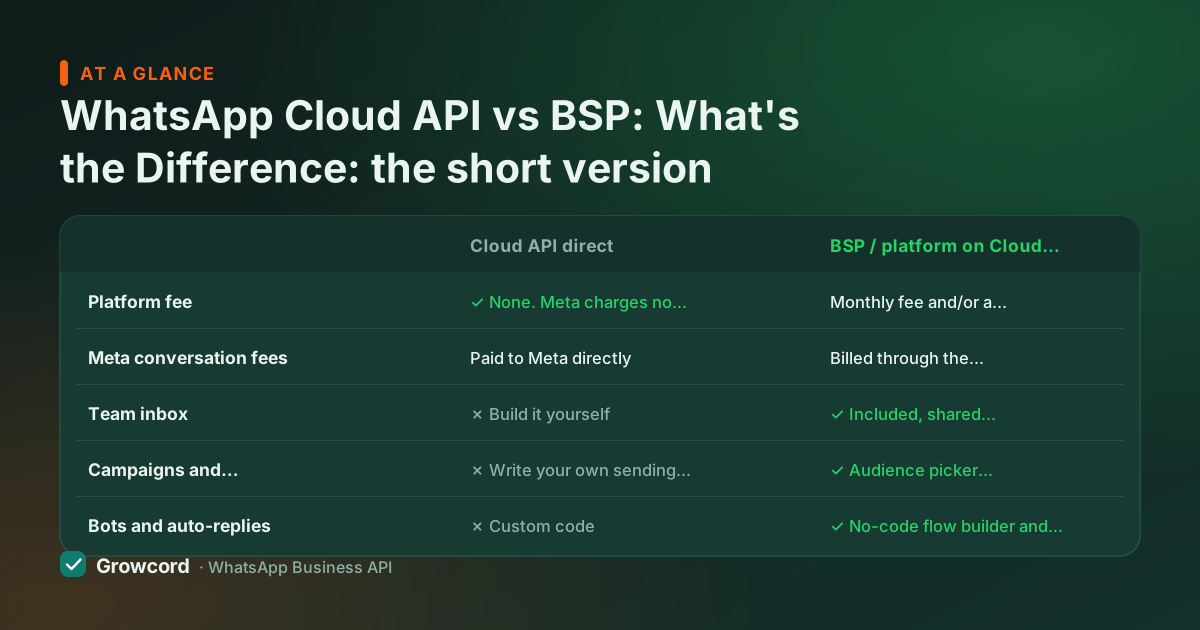
Cloud API direct vs through a BSP/platform
| Cloud API direct | BSP / platform on Cloud API | |
|---|---|---|
Platform fee | ✓ None. Meta charges no subscription | Monthly fee and/or a markup on messages |
Meta conversation fees | Paid to Meta directly | Billed through the provider, ask whether a margin is added |
Team inbox | ✗ Build it yourself | ✓ Included, shared, multi-agent |
Campaigns and broadcasts | ✗ Write your own sending logic | ✓ Audience picker, scheduling, reports |
Bots and auto-replies | ✗ Custom code | ✓ No-code flow builder and keyword auto-replies |
Template management | Meta's WhatsApp Manager | ✓ In-dashboard creation with approval sync |
Webhooks and integrations | Raw payloads to your server | ✓ Ready Shopify/WooCommerce/Zapier connectors, plus raw API |
Engineering needed | ✗ Significant, ongoing | ✓ None for daily use; API available when wanted |
Support | Meta documentation and tickets | ✓ The provider's team (Growcord: IST hours) |
Comparison of the two routes as they stand in August 2026. Meta's conversation fees apply identically on both.
The BSP partner difference, and what to watch in pricing
What a BSP or platform really sells is the operating layer: onboarding done for you through embedded signup, a shared inbox your team can use on day one, campaign and bot tooling, template management with approval status synced from Meta, and a human to ask when something breaks.
For a business without spare engineers, that layer is the difference between "we have API access" and "we actually run support and marketing on WhatsApp".
The pricing models are where providers differ most, and where you should read carefully:
- Per-message markup: a paisa margin added to every Meta conversation fee. Looks small, compounds at volume.
- Flat subscription: a monthly platform fee with Meta's fees passed through. Predictable; the model most India-focused platforms use.
- Both at once: common enough that it's worth asking the question explicitly.
Growcord uses the flat model: Basic ₹299/month (₹99 billed yearly) through Enterprise ₹5,999/month (₹2,999 yearly), with Meta's conversation fees passed through as prepaid credits at Meta's published rate, zero markup, and the rate is visible before you top up.
Subscriptions carry a 7-day money-back guarantee; unused credits stay in the wallet, and delivered conversations aren't refundable because Meta has already charged for them. The pricing page lays every plan out, and our comparison of Indian API providers puts the market side by side.
Beyond price, ask any provider three questions before signing. Who owns the WhatsApp Business Account? With embedded signup done right, the WABA is created under *your* Meta Business Manager, you keep the number and the asset if you ever leave. Can I export my data? Contacts and chat history should leave with you. Is there real API access? A platform that also exposes REST endpoints and webhooks means you're not choosing between convenience and control, you get the dashboard now and custom integration whenever you want it.
So which should you choose?
Go direct to the Cloud API if WhatsApp is a component of software you're building, you have developers to own the integration, and your team never needs to read chats in a UI. Go through a platform if human agents answer customers, marketing runs campaigns, or you want automations without building them, which in practice describes most businesses.
And since everything is Cloud API underneath, this isn't a one-way door: a platform with proper embedded signup and API access gives you the direct route's flexibility whenever you grow into it.
How connecting through Growcord works
Sign up and start embedded signup
The Meta-hosted flow opens inside Growcord. You log in with your Facebook account and the WhatsApp Business Account is created under your own Meta Business Manager.
Connect a number
A fresh number or one migrated from the Business app. Verification is an OTP; the number is live on the Cloud API in minutes.
Work from the dashboard, or the API
Inbox, campaigns, bots and templates are ready immediately. Developers can generate API keys and register webhooks from day one.
The official Cloud API, with the operating layer included
Growcord is built on Meta's Cloud API. Your WABA stays yours, plans start at ₹99/month billed yearly, and the free tier covers 50 conversations a month.
Start free, no card neededWhy Growcord
What you get here that you don't get elsewhere
Frequently asked questions
Is the WhatsApp Cloud API free?
Meta charges no subscription for Cloud API access, you pay only per-conversation fees when you message customers. But "free" covers the raw API only: there's no inbox, campaign tool or bot builder, so you either build those or pay a platform for them. Free tiers like Growcord's (1 number, 50 conversations/month) exist to try the full stack.
Do I need a BSP to get the WhatsApp Business API?
No, since the Cloud API opened in 2022, any business can connect directly through Meta with a Facebook Business account and a phone number. BSPs and tech providers remain the practical route when you want ready software and support instead of building on the raw API yourself.
What is the difference between the Cloud API and the Business API?
Today, effectively nothing, the Cloud API is the WhatsApp Business API, hosted by Meta. Historically "Business API" also covered the On-Premises version that BSPs self-hosted, but Meta retired that in late 2025. As of August 2026 all providers, BSP or not, run on the Cloud API.
Who owns my WhatsApp Business Account if I sign up through a platform?
With Meta's embedded signup done properly, you do. The WABA is created under your own Meta Business Manager, and the platform is granted access to operate it. That's how Growcord connects numbers. Be cautious with any provider that creates the WABA under its own Business Manager, because leaving them then means losing the asset.
Can I switch from a BSP to the Cloud API directly, or to another provider?
Yes. Numbers can be migrated between providers, and if your WABA already sits in your own Business Manager the move is mostly re-pointing the number and webhooks. Approved templates and your Meta-side history move with the WABA; platform-side data like chat history and contacts depends on the provider's export options, check before you need it.
Are Meta's message charges different through a BSP?
Meta's list rates are identical for everyone; the difference is what the provider adds. Some BSPs add a per-message margin, others charge a flat platform fee, some do both. Growcord charges the plan fee only, Meta's fees are passed through as credits at Meta's published rate with zero markup. Whoever you're evaluating, ask for the all-in price per message at your monthly volume.
Why businesses pick Growcord
Official WhatsApp Business API
Built on Meta's Cloud API, the sanctioned channel, not a modded app. No number-ban roulette.
Indian pricing, GST invoice
Plans from ₹99/month billed yearly. Paid in ₹ via Razorpay, with a proper GST invoice every time.
Free tier, no card needed
1 number and 50 conversations a month to prove it on real customers before paying anything.
Support from New Delhi, in IST
A real team on email and WhatsApp, Monday to Saturday 10:00–19:00 IST, not a ticket void.
Talk to us
Get set up on WhatsApp this week
Tell us what you sell and how many customers you message. We'll reply on WhatsApp with the plan that fits and, if you want it, walk you through the Meta approval step.
- No sales call unless you ask for one
- Answers from the team that builds it, in IST hours
- Free tier available. You can start before you decide
Keep reading
Related guides and comparisons
Last updated: 2026-08-07