

Where RTO actually comes from
RTO, return to origin, is what happens when a shipped parcel fails delivery and travels back to you. Every one costs forward shipping, reverse shipping, repacking and two to three weeks of stock stuck in transit; sellers typically put the all-in damage at a few hundred rupees per failed order before counting damaged product. But "RTO" is not one problem. It's four, and each has a different fix:
- Orders that were never real, junk orders, competitor mischief, a child with a phone, a mistyped number. These should die before a courier is booked.
- Impulse orders that cooled off, the customer meant it at midnight and doesn't by Tuesday. Catchable with a confirmation step, or a refusal at the door if you skip it.
- Address and reachability failures, incomplete addresses, wrong pincodes, phones that don't pick up. Fixable in chat before dispatch, expensive at the doorstep.
- Failed delivery attempts (NDR), customer wasn't home, didn't have cash ready, courier couldn't find the place. Recoverable, but only if you act the same day.
Most stores only ever see one aggregated RTO percentage on the courier bill, which is why the problem feels unfixable. Those four causes fall into the three stages named at the top of this page: kill the bad orders before dispatch, move the good ones to prepaid, and rescue the failed attempts the same day. The six levers below sit inside those three stages.
The six RTO levers, in order of impact
Pre-ship COD confirmation
An automated template with Confirm/Cancel buttons fires the moment a COD order lands. Fake and cold orders stop here, before courier charges.
Address check in the same message
The confirmation echoes the delivery address back, so a wrong pincode gets corrected in a reply instead of at the doorstep, no second message, no second fee.
COD-to-prepaid nudge
A payment link plus a small incentive converts committed buyers to prepaid, and a prepaid order can't refuse itself at the door.
Pre-delivery reminder
A message the day the parcel is out for delivery, amount payable, keep cash ready, cuts the 'wasn't expecting it' refusals.
Same-day NDR follow-up
When a delivery attempt fails, a WhatsApp message asks the customer to pick a resolution, reattempt tomorrow, new address, or cancel, before the courier gives up.
Repeat-offender tagging
Customers whose orders came back before carry a tag. Ship their next COD order only after confirmation, or offer prepaid only.
Setting the playbook up in Growcord
Connect your store
Shopify and WooCommerce connect natively, so new COD orders trigger the confirmation flow automatically. Custom carts and ERPs trigger it through a webhook.
Approve the templates
Confirmation with buttons, pre-delivery reminder, NDR follow-up, order-related utility formats, submitted to Meta from inside Growcord. They typically approve fast.
Decide your silence rule
Choose what happens to unconfirmed orders: auto-hold, one evening reminder, a verification call queue, or ship-but-deprioritise. Your margins, your rule.
Wire the NDR trigger
Your shipping aggregator or courier panel fires Growcord's webhook (or a Zapier zap) on a failed attempt, and the follow-up message goes out while the parcel is still in your city.
Watch the tags, not just the rate
Confirmed, unconfirmed, address-corrected, NDR-recovered, orders carry their status in Growcord, so you can see which lever is earning.
What each message costs vs what it saves
| Message | Category | Approx. cost | What it prevents |
|---|---|---|---|
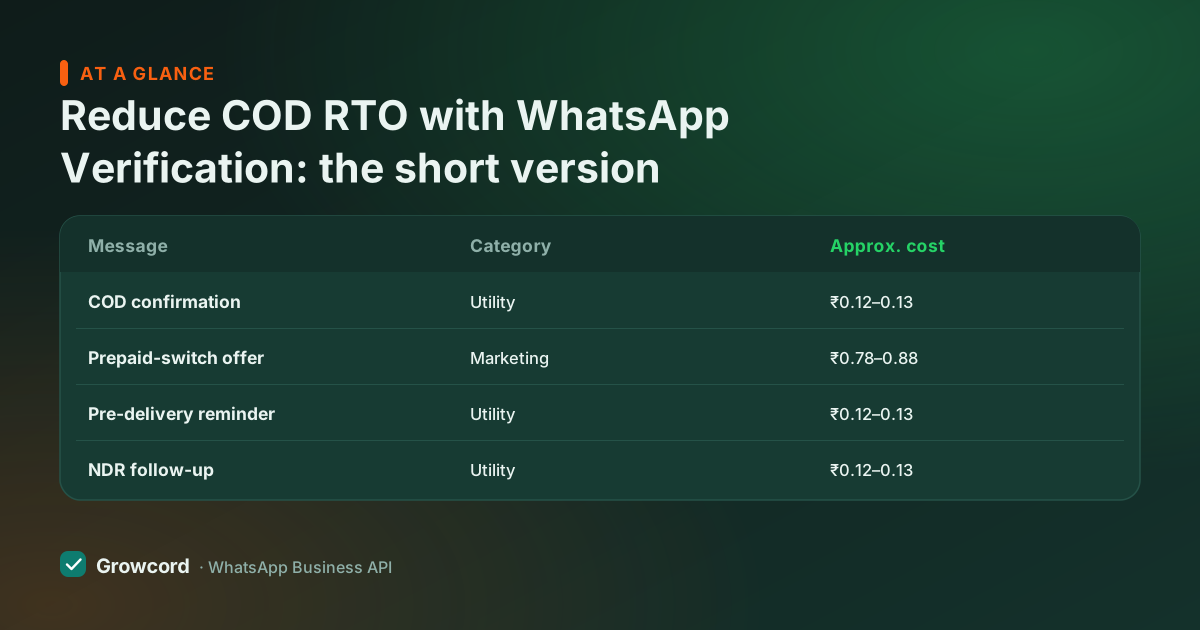
COD confirmation | Utility | ₹0.12–0.13 | Fake and cold orders shipping at all |
Prepaid-switch offer | Marketing | ₹0.78–0.88 | Doorstep refusal on converted orders |
Pre-delivery reminder | Utility | ₹0.12–0.13 | 'No cash ready / wasn't expecting it' failures |
NDR follow-up | Utility | ₹0.12–0.13 | A ₹200+ RTO after a failed attempt |
Meta conversation rates for India, approximate, checked August 2026, exact figures show in Growcord before sending. RTO cost assumes a conservative ₹200 per failed order in two-way shipping and handling.
NDR follow-up: the save most stores never attempt
A failed delivery attempt is not a lost order, couriers usually make two or three attempts before returning a parcel. The problem is the loop: the courier's NDR reason ("customer not reachable") sits in a panel nobody checks daily, the reattempt happens blind, fails again, and the parcel comes home.
Industry write-ups commonly report that a large share of NDR orders can be recovered with a structured same-day follow-up, which is exactly what a WhatsApp message with buttons does. "The courier couldn't deliver today. Reattempt tomorrow / Share a new address / Cancel the order." The customer answers in one tap, you push the answer back to the courier, and a doomed reattempt becomes a delivery.
The arithmetic, honestly
Take your own numbers. A store doing 800 COD orders a month at a 25% RTO rate eats 200 returns; at a conservative ₹200 each that's ₹40,000 a month before damaged stock. Running the full playbook, confirmation, reminder, and NDR follow-up on every order, costs roughly ₹300–400 a month in utility conversations.
We deliberately won't promise "cut RTO by 40%": your result depends on your traffic quality, your couriers and your pincodes. But the wager is a few hundred rupees against tens of thousands, measured on your own dashboard within one month. Start with COD confirmation, it's the highest-impact single lever, then add order notifications and the prepaid nudge via payment links.
What it costs to run
The automations are included in Growcord plans, from ₹299/month, ₹99/month billed yearly, and the free tier (1 number, 50 conversations a month) will verify your next 50 COD orders at no plan cost. Meta's utility rate applies per message as above; the pricing page has the full table.
Make RTO a number you control, not a tax you pay
Connect your store, approve three templates, and every COD order gets verified, reminded and chased. Free tier: 50 conversations a month.
Start free, no card neededWhy Growcord
What you get here that you don't get elsewhere
Frequently asked questions
What is RTO in ecommerce?
RTO, return to origin, is when a shipped parcel fails delivery and is returned to the seller. On COD orders it's the biggest hidden cost in Indian e-commerce: you pay forward and reverse shipping, repacking, and lose two to three weeks of stock in transit. Indian COD RTO rates are commonly reported between 20% and 35%.
How do I reduce COD RTO?
Work all three stages: verify COD orders on WhatsApp with Confirm/Cancel buttons before shipping, offer a payment link to convert committed buyers to prepaid, remind customers on delivery day to keep cash ready, and follow up every failed delivery attempt the same day with reattempt/new-address/cancel options. Each stage removes a different slice of returns.
How do I stop fake COD orders?
Require confirmation before shipping. A genuine buyer taps Confirm within minutes of ordering; junk orders, competitor mischief and mistyped numbers stay silent. Hold unconfirmed orders, or route them to a quick verification call, and tag customers whose orders previously returned so their next COD order ships only after an explicit confirmation.
What is NDR follow-up on WhatsApp and how does it work?
NDR (non-delivery report) is the courier's record of a failed delivery attempt. The follow-up: your shipping panel triggers Growcord through a webhook or Zapier, and the customer instantly gets a WhatsApp message with buttons, reattempt tomorrow, share a new address, or cancel. Their answer reaches you before the courier's next blind attempt, which is how NDRs become deliveries instead of RTOs.
How much does RTO actually cost per order?
Sellers typically estimate a few hundred rupees per failed order, forward shipping, reverse shipping and repacking, commonly around ₹150–300 depending on courier and zone, before counting damaged or unsellable stock and the two to three weeks the inventory spends in transit. Multiply by your monthly return count and the number is usually larger than expected.
Should I just turn off COD instead?
Usually not, COD still drives a large share of Indian e-commerce orders, especially outside metros, and switching it off costs real revenue. The better sequence: verify COD orders before shipping, nudge confirmed buyers toward prepaid with a small incentive, and restrict COD only for repeat offenders or consistently bad pincodes. You keep the sales and shed most of the risk.
Why businesses pick Growcord
Official WhatsApp Business API
Built on Meta's Cloud API, the sanctioned channel, not a modded app. No number-ban roulette.
Indian pricing, GST invoice
Plans from ₹99/month billed yearly. Paid in ₹ via Razorpay, with a proper GST invoice every time.
Free tier, no card needed
1 number and 50 conversations a month to prove it on real customers before paying anything.
Support from New Delhi, in IST
A real team on email and WhatsApp, Monday to Saturday 10:00–19:00 IST, not a ticket void.
Talk to us
Get set up on WhatsApp this week
Tell us what you sell and how many customers you message. We'll reply on WhatsApp with the plan that fits and, if you want it, walk you through the Meta approval step.
- No sales call unless you ask for one
- Answers from the team that builds it, in IST hours
- Free tier available. You can start before you decide
Keep reading
Related guides and comparisons
Last updated: 2026-08-07